
Should I Rent or Sell My Home? A Buffett-Style Way to Think About It
One of the most common questions we get is:
“Should I rent or sell my home?”
I’ve always thought it would be interesting to get an answer from someone everyone respects and many consider the greatest investor in the world.
But I don’t have Warren Buffett’s phone number, so I did the next best thing.
I asked ChatGPT to pretend it was Warren Buffett and answer the question.
Here’s the answer.
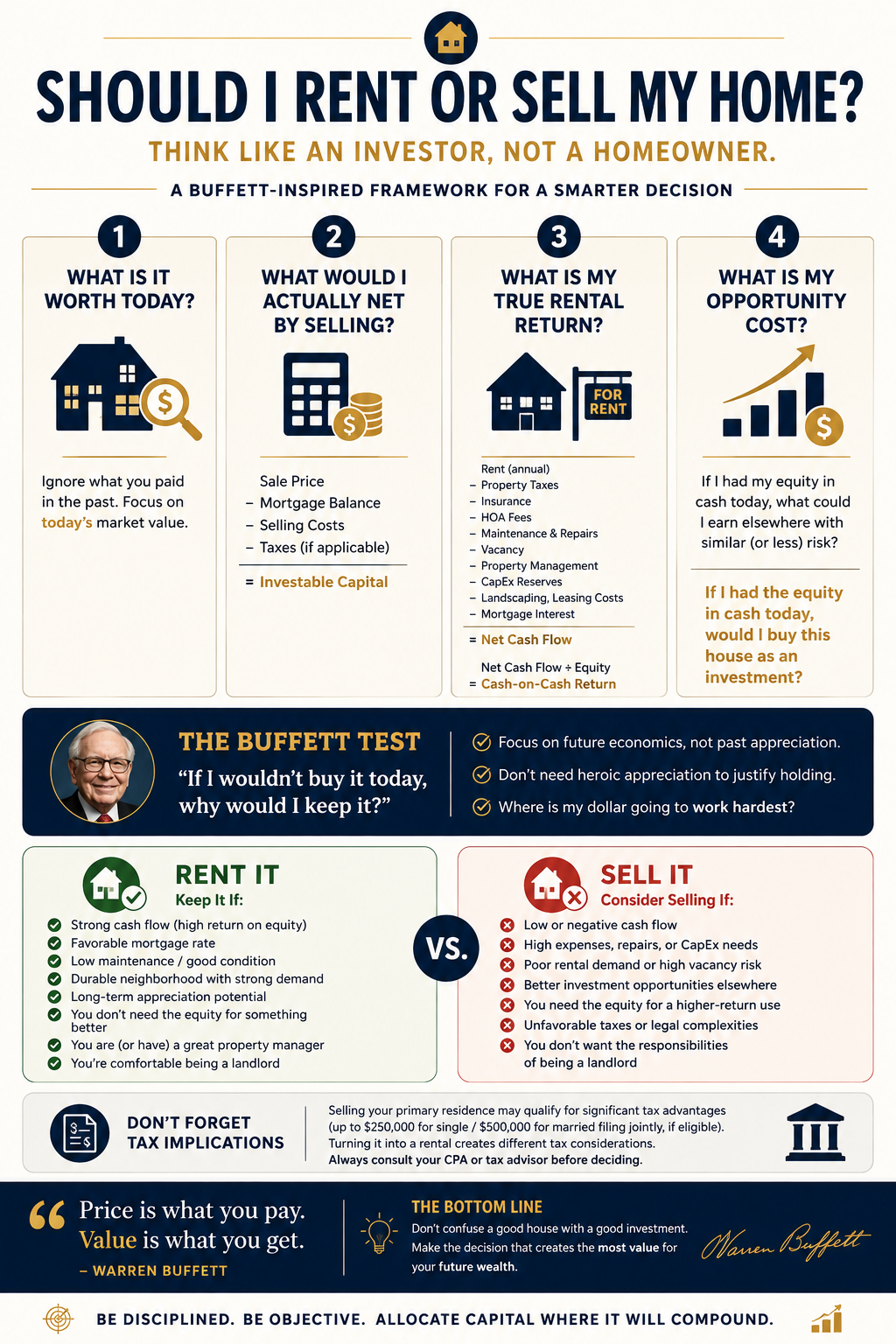
“Which choice gives you the better risk-adjusted return on the equity you have tied up in the house?”
Here’s how I’d think about it.
1. Forget What You Paid for the House
What matters is what the house is worth today.
If your home is worth $700,000 and you have $300,000 of equity in it, the relevant question isn’t whether you originally paid $400,000.
The question is:
“If I had $300,000 cash today, would I choose to invest $300,000 in this house?”
If the answer is no, that tells you something.
2. Calculate the Real Return From Renting
Don’t look at rent minus the mortgage payment and call that your profit.
I’d subtract:
-
Property taxes
-
Insurance
-
HOA
-
Maintenance and repairs
-
Property management
-
Vacancy
-
Landscaping
-
Major capital expenditures
-
Leasing costs
-
Expected depreciation and turnover
-
Mortgage interest
-
Eventually, the cost of replacing the roof, HVAC, and other major items
Then determine what you’re actually earning on your equity.
Example
$700,000 home
$300,000 equity
$3,500/month rent = $42,000/year
Suppose all expenses other than principal repayment consume $22,000 per year.
You’re left with roughly $20,000 of pre-tax cash flow.
That’s only a 6.7% cash return on your $300,000 of equity—before considering appreciation, taxes, and your time.
And that’s where I’d become particularly interested.
3. Don’t Underestimate the Opportunity Cost
This is probably the biggest mistake homeowners make.
If selling gives you $300,000 of investable capital, you should compare:
Keep the House
Cash flow + potential appreciation + mortgage principal reduction
Sell the House
Net proceeds invested elsewhere + whatever housing costs you have after selling
If you can reasonably earn a better return elsewhere without taking substantially more risk, keeping the rental may not be the best allocation of capital.
Buffett would probably ask:
“Where is my dollar going to work hardest?”
4. A Great Rental Can Be Worth Keeping
I wouldn’t automatically sell.
I’d be inclined to keep a property if:
-
The rent produces strong cash flow relative to the home’s current value.
-
The neighborhood has durable demand.
-
The property doesn’t require excessive maintenance.
-
You have a favorable mortgage rate.
-
You expect long-term appreciation.
-
You don’t need the equity for something more attractive.
-
You don’t mind being a landlord.
A particularly attractive situation is when you have a low fixed-rate mortgage and the property is generating good cash flow.
That’s cheap leverage on an appreciating asset.
5. But Don’t Fall in Love With the House
This is where I’d channel Buffett most strongly.
A homeowner might say:
“But this house has gone up so much. I don’t want to sell it.”
I’d respond:
That’s irrelevant.
Past appreciation doesn’t make the property a better investment going forward.
Likewise:
“I think Austin real estate is going to go up another 20%.”
Maybe it will. Maybe it won’t.
You shouldn’t need heroic appreciation assumptions to justify holding an investment.
I’d want the property to make sense even if appreciation is modest.
6. Consider the Tax Consequences Carefully
This can dramatically change the answer.
If it has been your primary residence, selling may provide significant tax advantages under the U.S. home-sale exclusion rules, assuming you meet the requirements.
Turning a former primary residence into a rental can also create depreciation and eventual capital-gains and depreciation-recapture considerations.
So I’d have a CPA run the numbers before deciding.
7. The Buffett Test
I’d boil the entire decision down to four questions:
1. What is the house worth today?
2. How much money would I actually walk away with if I sold it?
3. What annual return am I realistically getting by keeping it as a rental?
4. If I had the sale proceeds in cash today, would I voluntarily buy this exact house as an investment?
That last question is the killer.
If you wouldn’t buy it today, why own it?
And One More Thing Buffett Would Probably Emphasize
Don’t confuse a good house with a good investment.
You can have a beautiful home in a fantastic neighborhood that is a mediocre rental investment.
And you can have an ugly little property that produces an outstanding return.
The investment decision should be based on future economics, not attachment to the property.
Want to Run the Numbers?
If you give me the home’s current value, mortgage balance/rate/payment, realistic monthly rent, property taxes, insurance, HOA, and approximate maintenance costs, I can run the numbers and show you the “Buffett-style” rent-vs.-sell calculation, including the opportunity cost of the equity.
Enjoy this blog post? Click here to subscribe for updates
Leave A Comment